

Kawene new 3MW solar farm commissioned
April 14, 2026 10:11 pm | Posted in Business News | Share now TwitterFacebook
By Anita Roberts.
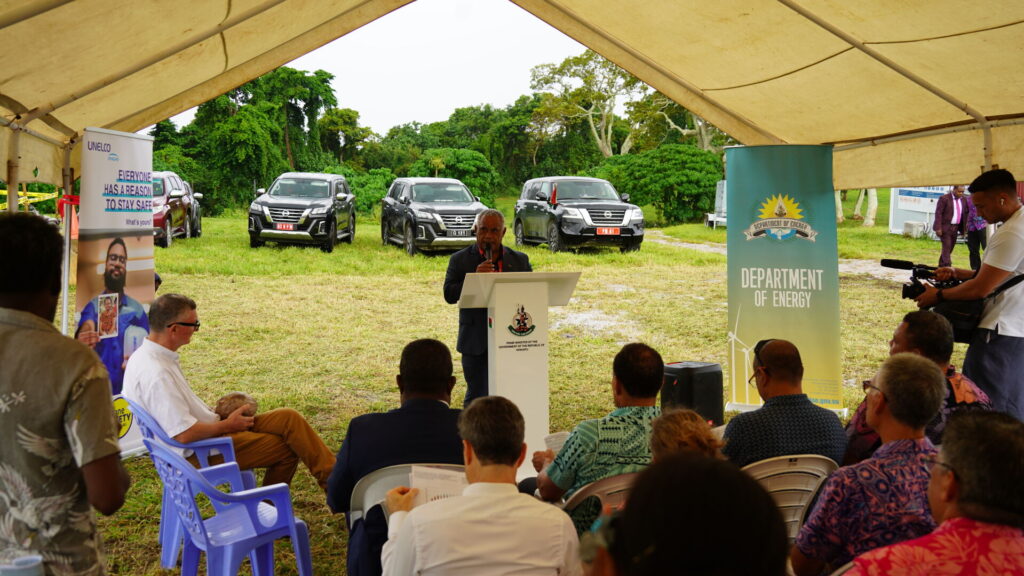
Renewable energy on Efate has taken a leap with the commissioning of a VT300 million new 3 megawatt (MW) solar farm at Kawene plateau yesterday.
The Kawene Solar Farm is Vanuatu’s largest solar project. Financed under the concession agreement between the Vanuatu Government and UNELCO, the 3MW solar farm supports efforts to reduce reliance on fossil fuels.
Over the past 20 years, UNELCO has generated more than 141 GWh of electricity from coconut oil, wind, and solar power, making up nearly 12% of the energy produced since 2006. This figure has risen to 21% between 2013 and 2026, with a mixture of copra oil, wind, and photovoltaic power.
General Manager (GM) of UNELCO, Frédéric Petit, said the new 3MW solar farm will generate 4 GWh of electricity annually, which is an addition of 6 percent to the current renewable energy generation.
The initiative demonstrates how to tackle climate change and global warming while reducing dependence on global fuel markets, given the current geopolitical situation, he said.
GM Petit took the opportunity to announce that the New Zealand Ministry of Foreign Affairs and Trade (MFAT) and the French Development Agency (AFD) will provide an 8 MW/9 MWh battery storage and stabilisation system, including an additional 5 MWp of solar capacity by 2027–2028, as part of the RESSET Project.
He said further funding from the Vanuatu Government will include two dedicated 800 kVA generators to enable the resumption of electricity generation from copra oil as early as next year.
“These additions to our current capacity will enable us to achieve a renewable energy penetration rate of around 42% by 2028,” he said.
GM Petit made a call on development partners to support Vanuatu in achieving its renewable energy goals.
In his remarks, Prime Minister (PM) Jotham Napat also urged development partners to scale up investments in renewable energy, grid systems, and storage.
He stressed that nearly 90 percent of electricity generation on Efate still depends on imported fossil fuel.
“That dependence exposes us to shocks we do not control. But today (yesterday), we take a step to change that. This 3 megawatt solar farm will increase renewable energy installed capacity from around 10 percent to 16 percent. It is a small step in numbers, but a powerful step in direction,” he said.
The PM said Vanuatu is progressing towards a just transition away from fossil fuels, island by island.
“In Santo, hydro developments will soon bring renewable energy penetration to over 90 percent. In Malekula, hydro is already helping reduce reliance on diesel. In Tanna, the transition is beginning to take shape. And now Efate,” he said.
He added that yesterday’s commissioning is fitting as important discussions are taking place in Port Vila by Pacific Small Island Developing States (PSIDS) ministers who are not just talking about just transition, but witnessing it in action.