

Villagers embrace new lifestyle with access to electricity
March 26, 2026 12:06 am | Posted in Business News | Share now TwitterFacebook
By Hilaire Bule.
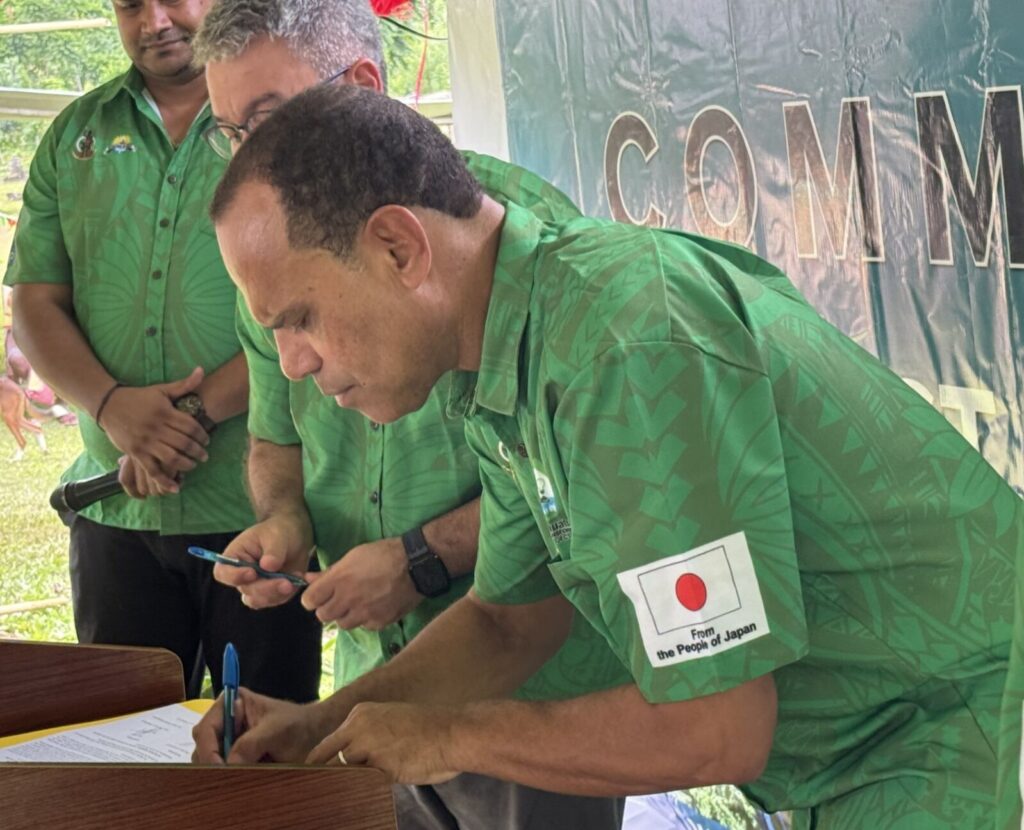
Villagers at Waterfall, Melsisi and Larimaat on Pentecost are embracing a new lifestyle as electricity is introduced through pico-hydropower stations.
Funded by the Government of Japan through the UNDP Vanuatu Green Transformation Project (VGET), the hydropower investment is delivering electricity to 706 connections across homes, businesses and public institutions across connected to the mini-grid system.
The officer in charge of Melsisi Health Centre, Marie Liwuslili, said they have been able to provide 24/7 service to the community since the arrival of electricity generated from the Melsisi Hydropower Station.
A teacher at Melsisi School, Albert Vireibo, said the investment will greatly benefit students by allowing them to do their homework at night.
He said since the electricity was connected to their homes, classrooms, and classrooms last month, it has improved both students’ studies and school administration’s work.
A woman from Pangi in south Pentecost, Rissa William, said the hydropower stations will bring changes to traditional ways of life, particularly in cooking.
”Cooking in an electric pot will not have the same taste as cooking over fire in or in a traditional oven,” she remarked.
Chairman of the Malbangbang Council of Chiefs, Chief Pita Watas, acknowledged that while electricity brings change, it also impacts the lives of people. He noted that development often comes with side effects, and it is now up to the people to manage their habits.
”We know that people of Pentecost will now buy chicken wings and stock them in the fridge. This will encourage non-communicable diseases, but we have to control what we are eating,” he said.
One of the country’s largest church mission, Melsisi Catholic Mission, will no longer needs to buy fuel for its generator. Father Philippe Gihala said the mission has stopped purchasing fuel since gaining access to electricity.
He explained that in the early 1960s, the mission brought generators to provide electricity to the mission but now they are using power from hydro.
The renewable infrastructure is electrifying approximately 16 percent of Pentecost population based on 2020 census.
The three stations are offering a combined generation capacity of 63 kilowatts and will produce approximately 549, 340 kilowatts of electricity annually supported by 154 kilowatts battery storage providing a maximum available annual energy of 640,785 kilowatts.
Minister Regenvanu, on behalf of the Vanuatu Government thanked the people and government of Japan for their investment in the development of Vanuatu’s renewable energy.
He said the government, through the Ministry of Climate Change and Energy, will open a tender for companies interested in managing the pico-hydropower stations on Pentecost.
He conveyed this following the launch and handing over of the small hydropower stations at Waterfall, Melsisi, and Larimaat villages to the government on Tuesday.
Regenvanu said Pentecost island will be next island to receive a concession for managing its hydropower projects, following the models on Efate managed by UNELCO, Vanuatu Utilities and Infrastructure (VUI) on Santo and VanPower on Tanna and Malekula.