
Tourism review begins in Santo
July 9, 2026 11:25 pm | Posted in Business News | Share now TwitterFacebook
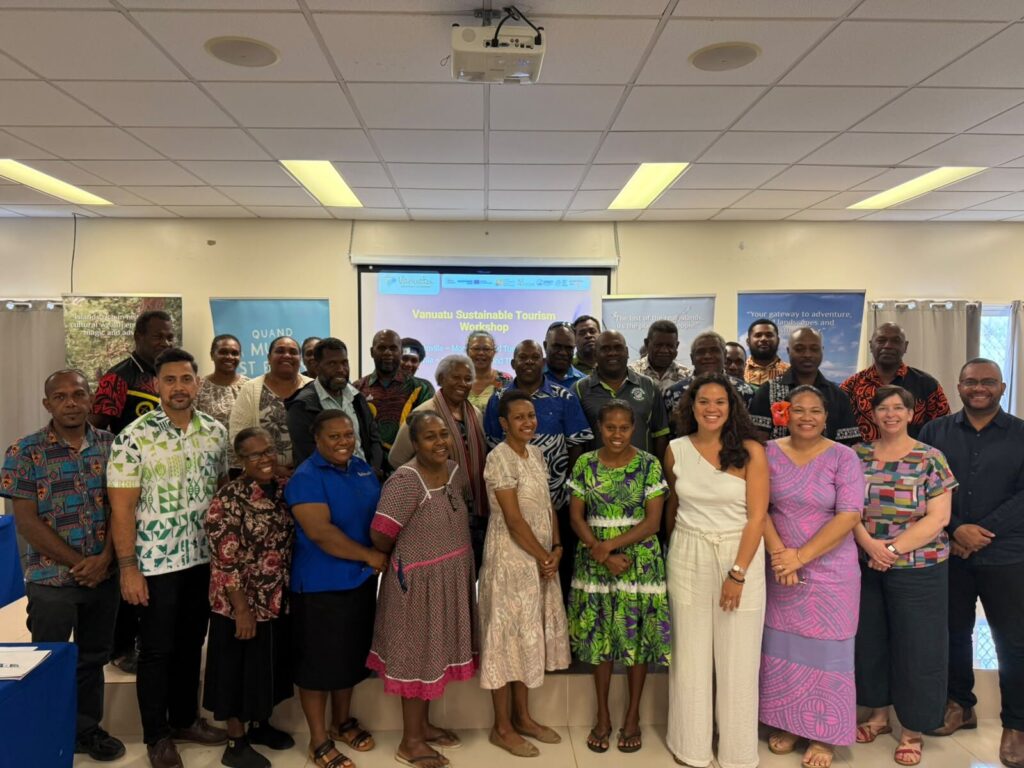
The Department of Tourism (DoT), under the Ministry of Trade and Commerce (MoTC), has completed a two-day consultation in Luganville, gathering feedback from tourism operators, government agencies and development partners on proposed reforms to Vanuatu’s tourism sector.
The workshop, held at the Vanuatu National Provident Fund (VNPF) Building, is the first in a series of national consultations that will continue in Port Vila as the department reviews tourism permits, accreditation standards and the country’s sustainable tourism strategy.
The Luganville consultation, held on July 6 and 7, 2026, forms part of the wider Vanuatu Sustainable Tourism Workshop series, which continued in Port Vila on July 8 and 9, 2026.
The workshop is supported by the Pacific Tourism Organization (SPTO), the Secretariat of the Pacific Regional Environment Programme (SPREP), and the EU Global Gateway-funded SWITCH-Asia Pacific Sustainable Enhancement in the Pacific (STEP) Programme, which are providing technical and financial assistance for the consultation.
Opening the workshop in Luganville, Director of Tourism Paul Pio said the reforms aim to modernise tourism systems to better meet the needs of a growing and increasingly competitive industry.
“This consultation is not simply about changing forms and processes — it is about building a tourism sector that works for Vanuatu, for our communities, for our environment and for the businesses and operators who invest in this country,” Mr. Pio said.
“The reforms we are discussing today — from how we issue permits to how we certify operators against sustainability standards — are designed to make it easier to do business, raise the quality of the visitor experience and ensure that tourism genuinely benefits ni-Vanuatu. We want operators to see government not as a hurdle, but as a partner in their success.”
A key focus of the Luganville workshop is the proposed modernisation of the Vanuatu Tourism Permit and Accreditation Programme (VTPAP) and the Vanuatu Tourism Operators Minimum Standards (VTOMS).
Participants have been presented with proposals to simplify the current permit process, which has been identified as creating unnecessary administrative burdens for operators and government.
Under the proposed framework, tourism permits and standards certification processes would have clearer purposes and procedures while remaining a one-time application requirement.
The permit process would move to a single-permit model requiring operators to declare all business classifications and locations, supported by a legal declaration of compliance with applicable Vanuatu laws.
Existing standards would transition into a new tiered Vanuatu Tourism Operator Sustainable Standards (VTOSS) framework, allowing operators to progress from a baseline level of compliance towards higher tiers of sustainability recognition, with access to incentives and support programmes linked to their level of achievement.
The proposed changes also aim to address delays between tourism permits and business licences, creating clearer pathways for operators, particularly those on the outer islands and in community-based settings, to enter and progress within the formal tourism system.
The consultation also addresses Vanuatu’s environmental sustainability commitments, with presentations from SPREP on the Standards and Certification Programme for Phasing Out Problematic Single-Use Plastics (SUPs) in the tourism sector.
The workshop explored the role tourism operators can play in reducing plastic pollution and how the proposed VTOSS framework can include environmental criteria aligned with Vanuatu’s existing laws and Pacific commitments.
The consultation also includes discussions on refreshing the Vanuatu Sustainable Tourism Strategy, guided by the Target 2030 framework.
The strategy’s five themes — Wellbeing through High Value, Low Impact Tourism; Resilience through Niche Tourism Product Development; Inclusion through Value Chains; Sustainability through Governance, Standards, Investment and Ni-Vanuatu Entrepreneurship; and the Vanuatu Sustainable Cruise Tourism Plan — provide direction for the sector through to 2030.
Participants are providing feedback on whether these priorities remain suitable for Vanuatu and how revised permit and standards frameworks can support their implementation.
The DoT said the consultation process is designed to capture practical experiences from industry operators, provincial offices, industry associations and development partners before reforms are finalised, with a pilot phase planned for Efate before national rollout.
The Luganville workshop gives Santo-based operators and stakeholders an opportunity to contribute to decisions that will affect how they operate, how they are recognised and how they are supported in the future.
The DoT, under the MoTC portfolio, is responsible for tourism policy, operator regulation, accreditation, standards and coordination with the Vanuatu Tourism Office and regional and international partners on matters affecting the development and sustainability of Vanuatu’s tourism sector.