

Hotel Santo’s 50th Anniversary and local economic footprint
August 18, 2026 11:11 pm | Posted in Business News | Share now TwitterFacebook
By Charles Hakwa.
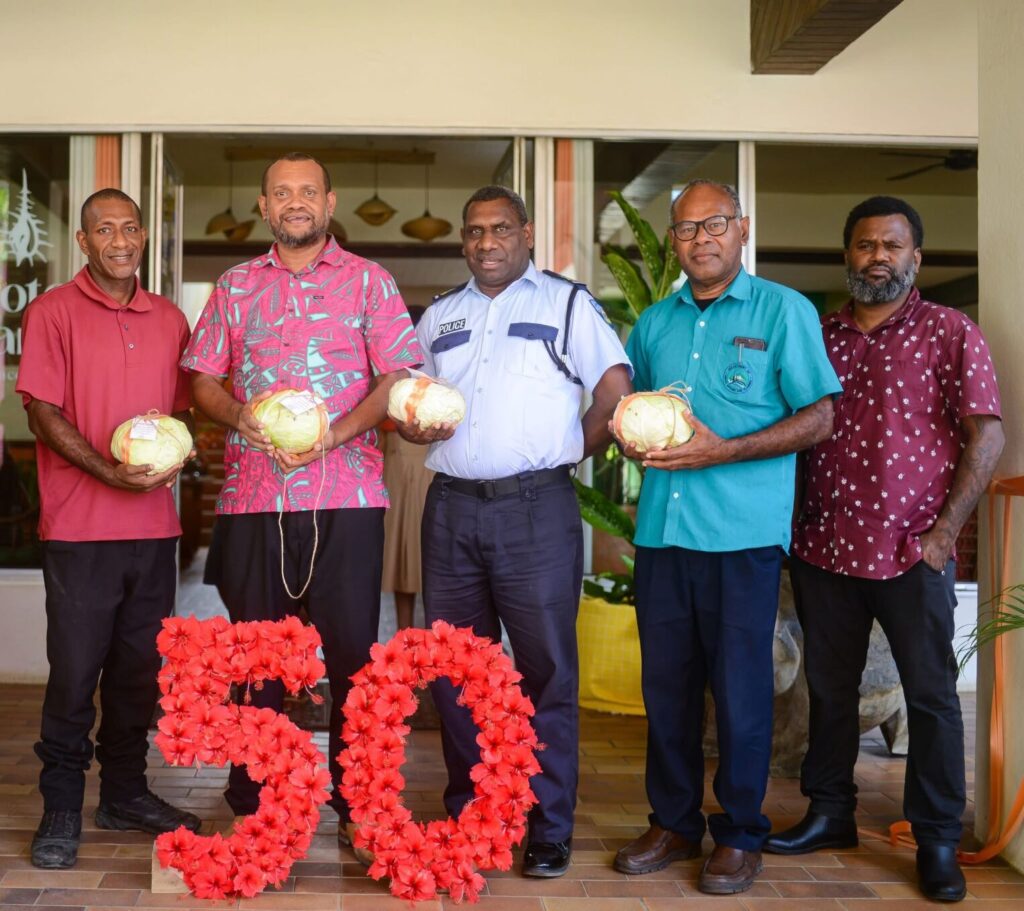
When a tourism property celebrates its golden jubilee, the focus naturally turns to history, nostalgia and decades of hospitality. Hotel Santo’s 50th-anniversary celebrations in Luganville have drawn praise for its half-century of continuous operation since 1976. However, beyond the anniversary speeches lies a deeper story for SANMA Province: the scale of the hotel’s local economic footprint and its resilience.
A recent example came at the hotel’s 50th-anniversary breakfast. Instead of purchasing imported corporate merchandise as guest takeaways, management went to Luganville Market and bought 50 whole island cabbages directly from market mamas, coordinating with the head mama who oversees daily operations.
”The money went directly to local families, through the hotel, and the cabbage went home to feed other local families,” says newly elected ESTA Chair and Hotel Santo executive Lisa Dinh, describing it as a small example of the “Hotel Santo style” economic multiplier.
For half a century, the hotel has demonstrated how tourism can keep money circulating within the local community.
A pillar of island identity
Minister responsible for Tourism Robson Iavro, who represents the Santo Rural constituency in Parliament, described Hotel Santo as a cultural and economic gateway for generations.
“For half a century, Hotel Santo has stood as a pillar of our Island’s Identity,” Minister Robson Iavro said. “From the first guests who arrived by sea to the international visitors we welcome by air today, this establishment has been the face of Espiritu Santo to the world. You have not only provided rooms and meals, you have provided memories, employment, and a standard of excellence that has lifted our entire tourism industry.”
“When we speak of the growth of Vanuatu’s tourism sector, we must speak of Hotel Santo,” he said. “You were pioneers when tourism here was in its infancy, and you remain leaders today. You have trained generations of Ni-Vanuatu hospitality workers, supported local businesses, and showcased the beauty of our Blue holes, our champagne beaches, treks and terrains, and the spirit of our people to the globe.”
”Your contribution to the economic and social fabric of Santo is immeasurable,” Iavro added. “While we celebrate this great institution, we must honour the hearts behind it. Thank you tumas, Mary Jane, Lisa, Kim and the Dinh Family in Santo.”
The Last Titan standing
Opening its doors in 1976, before Vanuatu gained independence, Hotel Santo is one of the last pre-independence businesses still operating in the country.
For Pekoa International Airport Air Traffic Service operator and Luganville resident Shaun Mackenzie-Reur, the property is more than a hotel; it is a city landmark that has outlasted pillars of old Santo commerce.
”Throughout that time, the hotel has witnessed major political, economic, and social changes in Luganville, Santo, SANMA Province, and Vanuatu as a whole,” Mackenzie-Reur said. “The hotel was open throughout the 1980 rebellion, through numerous earthquakes, cyclones, and through good times and bad times economically.”
”Others such as Allan Power Dive Tours, Burns Philp, Nitchiku Cattle Company, Lees Biscuits Factory, and Santo Meat Packers have all closed down,” he noted. “Hotel Santo is the last one standing. The end of an era.”
The blueprint for political and economic independence
Hotel Santo’s history is also intertwined with the birth of the Republic of Vanuatu. In a media release marking the golden jubilee, Vanuatu Tourism Office (VTO) Board Chairman Gideon George said the establishment provided a venue for meetings and political dialogue that helped pave the way for independence.
“Beyond its hospitality, we profoundly honour the historic significance of Hotel Santo for housing the monumental meetings and political dialogues that paved the way for our nation’s independence,” George said. “This Golden Jubilee celebrates that rich history, alongside the founders and guests who shaped its legacy. Congratulations to Hotel Santo on this incredible milestone, and wishes for continued success over the next 50 years!”
An anchor for regional decentralisation
Vanuatu Department of Tourism (DoT) Director Paul Pio said Hotel Santo’s long-term presence demonstrates the value of investment outside Port Vila.
”For half a century the hotel has been a continuous, stable source of private-sector activity in Luganville at a scale that few other businesses in the country can match,” Pio said.
”A property that keeps its doors open through economic cycles, natural disasters and shifts in the visitor market provides the steady employment, supplier demand and local spending that allow other businesses around it to plan and grow,” he said. “In that sense Hotel Santo has functioned as an anchor tenant for Luganville’s wider private sector, and it is a useful illustration of how long-term investment outside Port Vila strengthens the whole national economy.”
Pio also described the hotel’s local procurement practices as a model for linking tourism with rural productive sectors.
”When a property of this standing buys its produce, seafood and handicrafts from Sanma’s rural communities, the benefit of every visitor’s stay reaches households well beyond the hotel gate… into gardens, fishing communities and cooperatives across the province,” he said. “This is precisely the kind of linkage between tourism and the productive sectors that the Department wants to see more of. It keeps value in the local economy, supports agricultural and marine livelihoods and gives our rural communities a direct stake in the success of the industry.”
The hyper-local supply chain
Dinh said local procurement has long been central to Hotel Santo’s operations.
”Local procurement for us is not a new sustainability initiative or something we have introduced because ‘buy local’ has become fashionable,” she said. “It has always been part of the practical reality of running a locally owned hotel in Santo. Wherever possible, we buy locally: fruit and vegetables, fish and seafood, meat, coffee, transport and a range of services. We deliberately keep direct imports from Vila or overseas to a minimum.”
”Tourism expenditure also reaches people who may not necessarily think of themselves as part of the formal tourism industry — farmers, fishermen, market mamas, drivers, tradespeople and other small suppliers,” Dinh said. “For us, local procurement isn’t a CSR programme. It’s simply how a locally owned hotel participates in its own economy.”
She cited Santo coffee from VARTC as another example.
”We deliberately serve Santo coffee from VARTC, a research centre we should be proud to have here in Santo and in Vanuatu,” Dinh said. “Choosing their coffee rather than importing foreign beans is one small way we can support that work and keep our purchasing closer to home.”
However, local supply can be challenging.
”Local supply fluctuates. Seasonality exists. Consistency and volumes can be challenging,” she said. “There is a responsibility on tourism businesses to work with what is available locally. If we only choose local when it is cheaper, easier and as consistently available as an imported alternative, then it isn’t much of a choice at all.”
Tourism is everyone’s business
The procurement approach feeds into the wider economic multiplier effect. Money spent on hotel rooms circulates through staff wages, local produce, transport and maintenance services before being spent again in shops, on school fees and on local services.
Dinh recalled how Hotel Santo helped a local transport operator named Kenneth grow his business.
”As he remembers it, Hotel Santo became one of his stepping stones in business,” she said. “My mother, Mary Jane Dinh, and Hotel Santo helped finance his first bus. From those beginnings, Kenneth continued building his businesses. Today he owns Tropicana Motel, several shops, a rental-car business and accommodation in Port Vila. A hotel needed transport. That created business for a local operator. A long-term relationship and access to an asset helped that operator grow.”
Building human capital
Dinh said the hotel’s five decades of operation have also helped build local skills.
”Over five decades, people working in a hotel acquire skills in cooking, housekeeping, maintenance, administration, and customer service,” she said. “The skills developed inside Hotel Santo do not belong to Hotel Santo. They ultimately become part of Santo’s human capital.”
She cited several examples of multi-generational connections among staff, including breakfast chef Shareen, whose father worked at Hotel Santo in the 1980s, and third-generation staff member Janella, who assisted with clean-up operations after a cyclone.
”I share these stories because they reveal something employment statistics cannot measure: belonging,” Dinh said. “Over time, a workplace can become somewhere people feel they belong and are personally invested in its continuity. That matters economically too.”
A stable foundation for future growth
With Dinh recently elected Chair of the Espiritu Santo Tourism Association (ESTA), she also sees cooperation between established hotels and Ni-Vanuatu tourism operators as essential.
”An established hotel and a small Ni-Vanuatu tour operator are not competing parts of the tourism economy. We need one another,” Dinh said. “A hotel provides a bed base and an urban hub from which visitors can access the rest of the destination. Tour operators, dive operators, taxis, guides, restaurants, rural bungalows and attractions give visitors reasons to come to Santo, stay longer and spend more.”
That approach was tested during the COVID-19 tourism shutdown, when Mary-Jane Dinh chose to keep Hotel Santo open.
”She asked another question: what happens to the people who depend on the business if everybody closes?” Lisa Dinh recalled. “Our employees still had families. People still needed incomes. Suppliers still needed customers. For a locally owned business, responsibility isn’t only what you do with your profits afterwards. It can be embedded in the business itself: who we employ, who we train, who we buy from, and where the money goes next.”
As Luganville enters Hotel Santo’s next half-century, Dinh said the hotel’s relationship with the town remains central.
”Hotel Santo is not part of Santo simply because we are physically located in the centre of Luganville,” she said. “We have watched a town grow around us, and we have grown with it. For fifty years, Hotel Santo hasn’t simply operated Luganville. It operated with Luganville.”