
Japan-led project advances volcanic tsunami preparedness in Port Vila
May 7, 2026 11:08 pm | Posted in Business News | Share now TwitterFacebook
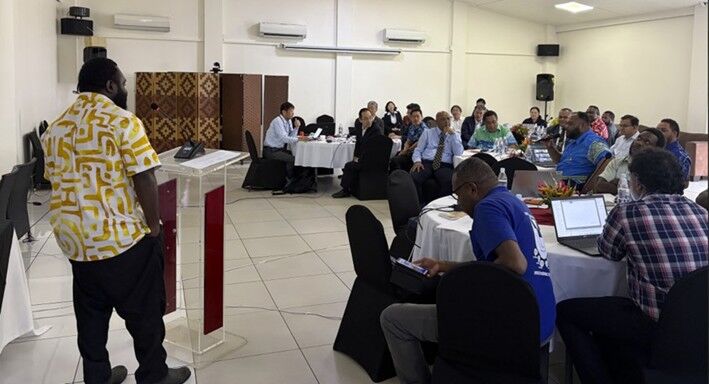
Efforts to improve volcanic tsunami preparedness across the Pacific have advanced in Port Vila, as experts from Vanuatu, Fiji, Tonga, and Japan reviewed progress on a major Japan-led disaster risk reduction project. The third Joint Coordinating Committee (JCC) meeting of the Project for Disaster Risk Reduction of Widespread Volcanic Hazards in Southwest Pacific Countries was held on April 23–24, 2026.
The project is led by Dr Mie Ichihara, Professor at the Earthquake Research Institute, the University of Tokyo, and is jointly funded by the Japan International Cooperation Agency (JICA) and the Japan Science and Technology Agency (JST) for a five-year period beginning in May 2024.
The initiative brought together geohazards and meteorology departments, disaster management agencies, and universities from Vanuatu, Fiji, and Tonga, in collaboration with Japanese experts.
The meeting was hosted by the Vanuatu Meteorology and Geo-Hazards Department (VMGD), with participation from the National Disaster Management Office (NDMO), the University of the South Pacific (USP) Emalus Campus, and the National University of Vanuatu (NUV). A total of 27 project members attended from outside Vanuatu, including 10 from Japan, 10 from Fiji, and 7 from Tonga.
The meeting opened with welcoming remarks from the Director General (DG) of the Ministry of Climate Change (MoCC), followed by a greeting from Japan’s Ambassador to Vanuatu, Naohisa Okuda. Project progress was then presented.
Geohazards Manager John Jr. Niroa reported on Vanuatu activities, including survey work in Gaua, Ambrym, and Tanna, development of volcano monitoring methods, and school-based awareness programmes in Tanna.
VMGD volcanology officer Ricardo William presented findings from training in Japan, which focused on microscopic analysis of volcanic ash from Ambrym. Dr Krishna Kotra, Deputy Head of the School of Agriculture, Geography, Environment, Ocean and Natural Sciences (SAGEONS) at USP Emalus Campus, outlined plans to apply project research to human resource development, following discussions in Japan with partners from Fiji and Japan.
Japanese experts presented research on eruption scenario modelling, historical volcanic tsunamis in the region, and monitoring systems. These findings will feed into the Standard Operating Procedure (SOP) for Tsunamis Generated by Volcanoes (TGV).
The SOP development is a key component of the regional geohazard strategy. A day before the JCC meeting, the second three-country workshop on the volcanic tsunami SOP was held. Under the leadership of Yuji Nishimae, former officer of the Japan Meteorological Agency and former chairperson of the ICG/PTWS, a draft SOP for TGV was developed. It is expected to be tested through a joint exercise in the three countries on World Tsunami Awareness Day later this year.
Human resource development remains another major focus of the project. A planned geological field lecture for National University of Vanuatu students was cancelled due to bad weather. Instead, NUV lecturer Robson Tigona organised a seminar featuring Professor Kazuhisa Goto and Associate Professor Fukashi Maeno from the University of Tokyo, who delivered lectures on tsunami history and volcanic eruption scenarios.
The project will continue for an additional three years. The activity plan for May 2026 to April 2027 was discussed and approved at the JCC meeting.
In Vanuatu, the eruption scenario team plans to conduct surveys at Ambrym Volcano in June, including drone-based observations. Field training is also planned at Yasur Volcano, allowing participants from Fiji, Tonga, and Japan to study an active volcano site.
Educational outreach will also continue, with lectures and simple experiments designed to explain volcanic eruption physics in schools in Port Vila.
These plans were formally agreed upon and signed by representatives from each participating country and JICA on April 24, 2026.