

Water crisis in Vanualava: Communities struggle as aging systems fail
April 6, 2026 11:50 pm | Posted in Business News | Share now TwitterFacebook
By Ezra Toara & Lynnette Melenamu.
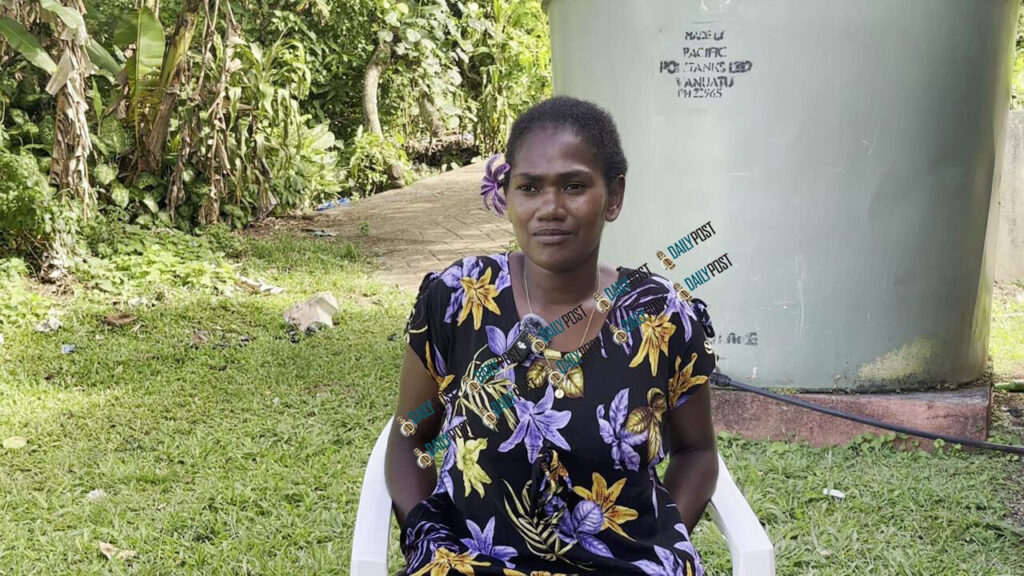
From Sola to Wasaka, communities in TORBA Province face daily water shortages as outdated infrastructure, population growth, and climate pressures strain fragile supply systems.
A daily struggle for water in the far north
In the far northern islands of Vanuatu, water is not just a basic need—it has become a daily struggle for many communities.
Across Vanualava Island in TORBA Province, families, schools, businesses, and local leaders are increasingly raising concerns about the reliability of water systems that once supported growing populations.
Residents say the situation has worsened over time as aging infrastructure, management challenges, and population growth place pressure on limited water sources.
Communities depend on an aging water system
In Sola, residents living on state land depend largely on a single water supply system that was established years ago through a project funded by the French government and implemented by the French Red Cross.
However, Chief George Augustus Ling said the system that once served the community effectively is now struggling to meet demand.
“My name is Chief George Augustus Ling. I speak not just for myself but for all families living on state land in southern Sola,” he said.
“We all depend on one water supply system that was built years ago through a project funded by the French Red Cross.”
Chief Ling explained that when the project was first introduced, it was designed to supply water to nearby schools and surrounding communities, with shared standpipes used to distribute water.
“At the beginning, the system worked well because there was cooperation between the school, the community, and the provincial government,” he said.
But over time, challenges emerged.
“Some households began installing their own private connections or modifying the pipes. This weakened the entire system and caused uneven water distribution.”
Today, the situation has deteriorated significantly.
“There are times when water flows only once a week, sometimes once every two weeks, and in some cases it may take up to a month before water reaches certain households,” Chief Ling said.
Families forced to find their own water sources
With the unreliable water supply, many residents have turned to alternative methods just to meet their daily needs.
“Many of us had to dig small wells just to survive,” Chief Ling said.
“In my own case, my brother and I dug an underground well and installed tanks to collect rainwater. But during the dry season, it becomes extremely difficult.”
Some families do not even have enough space to construct wells or water tanks.
“Sometimes I borrow drums or containers from friends just to store a little water. That is how serious the situation has become,” he said.
Chief Ling believes the aging system can no longer support the current population.
“Our population has grown, but the water system has not been upgraded,” he said.
“Water is life. If we do not improve this system, the crisis will continue.”
Disaster office monitoring water shortages
As water shortages become more frequent, reports are increasingly being submitted to the National Disaster Management Office (NDMO).
TORBA Provincial Disaster Officer Betsy Manliwos said the office follows a structured assessment process whenever communities report water challenges.
“When reports reach us through the Secretary General or Area Councils, we assess them using three scenarios: the best-case scenario, the likely scenario, and the worst-case scenario,” she said.
If the situation is serious, the matter is escalated to the national government.
“In the best-case scenario, the community or Area Council can manage the situation. In the likely scenario, the provincial government works with the NDMO and partners.
“In the worst-case scenario, national government and international support may be required,” Manliwos explained.
She cited last year’s drought season as an example, when several communities faced water shortages.
“We worked with partners including World Vision and other disaster risk reduction programmes to support affected areas,” she said.
Water trucking and long-term solutions
To support vulnerable communities, the provincial disaster office sometimes deploys emergency water trucking.
But Manliwos said the province is also working toward longer-term solutions.
“We are working on rainwater catchment systems in places like Merelava and supporting gravity-fed systems with the Department of Water Resources,” she said.
Saltwater intrusion is another emerging challenge.
“In low-lying areas, wells are becoming salty due to sea-level rise. Places like Pot Patsen Theological School now rely on water tanks we provided,” she said.
Support continues in islands including Merelava, Motalava, and Gaua, where communities frequently experience water shortages.
Businesses also feeling the pressure
The water crisis is not only affecting households but also local businesses.
Business owner Caleb Wilkins, who runs Wilkins Bungalow in Sola, says providing water for guests has become one of his biggest challenges.
“I come from Motalava but now live in Sola,” Wilkins said.
“I used to work as a planner with the TORBA Provincial Government, so I understand how the water system was supposed to function.”
Before piped water was introduced, communities relied on underground wells.
“When the water project stopped functioning, we had to return to the old wells again,” he said.
During low tide, the wells become unreliable, forcing businesses to carefully ration water.
“Sometimes we have to strictly control water use when guests arrive,” Wilkins explained.
“So yes, after the project ended, life returned to hardship.”
Schools forced to ration water
The water shortage also affects education.
At Baldwin Lonsdale Memorial College, around 320 students rely on a limited water supply system fed from a natural source in the hills.
Acting Principal Morris Mera, who began teaching at the school in 2020, said water management has become a daily priority.
“Our storage capacity is small, so we carefully monitor how water is used,” Mera said.
The school controls water distribution throughout the day.
“We turn the system on and off at specific times—at night, early morning, lunchtime, and again around 3pm.”
This schedule ensures students and staff have enough water for drinking, cooking, sanitation, and bathing.
“We store water in bathrooms and distribute it across the school compound to ensure everyone has access,” he said.
Despite these measures, the school still faces several challenges, including long travel distances for students, teacher shortages, and limited infrastructure.
Another priority, according to Mera, is improving school security.
“The school does not currently have proper fencing around the boundary. Installing fencing would help us manage access and improve student safety,” he said.
Village communities waiting for the tap
In Wasaka Village, water shortages are also a constant challenge.
Community leader Derrick Wembas said the village relies on water piped from a creek into storage tanks.
However, supply is often unpredictable.
“When the flow is low, our chief announces when the water will be turned on,” Wembas said.
“Everyone rushes to collect what they can—whether it’s strong flow or just a trickle.”
Sometimes the water does not come at all.
“So we wait and prepare our containers for the next chance,” he said.
Infrastructure challenges across TORBA
Aljerry Malantan, a Contractor Officer with the Department of Water Resources in Sola, said many communities across TORBA face serious infrastructure challenges.
“Some communities depend on gravity systems that do not supply enough water, while others rely on pumps that are failing,” Malantan said.
Even the main water tank in Sola is too small to support the growing population.
“The pipes are old, and many people do not receive enough water,” he explained.
To manage supply, water is now controlled at certain times.
“We turn it on at 6am and off at 8am, then again in the afternoon.”
Malantan said surveys have already been completed in several communities and submitted to the Department of Water.
“We are expecting European funding in 2026 to upgrade these systems,” he said.
In the meantime, authorities are supporting households with small containers to store drinking water and distributing bottled water during droughts.
However, Malantan warned that many water sources currently used by communities may not be safe.
“We do not have proper equipment to test the water, but people still drink it because they have no choice.”
Call for sustainable solutions
Across Vanualava, communities continue to adapt and survive using wells, rainwater tanks, and limited water supplies.
But local leaders say resilience alone is not enough.
With populations increasing and climate pressures intensifying, residents believe the time has come for major investment in water infrastructure.
Without sustainable systems, proper management, and long-term planning, the water crisis in the northern islands may only grow worse in the years ahead.
This project in TORBA Province on Vanualava Island focuses on the hidden truths surrounding water scarcity. The initiative shows the growing challenges communities face in accessing reliable water sources across the island. The project is supported by ABC in partnership with the Daily Post and involves interviews with several residents and community leaders to better understand the impact of water shortages on daily life.