

New Oceans Bill to boost economy and secure resources
November 11, 2025 10:04 pm | Posted in Business News | Share now TwitterFacebook
By Terence Malapa.
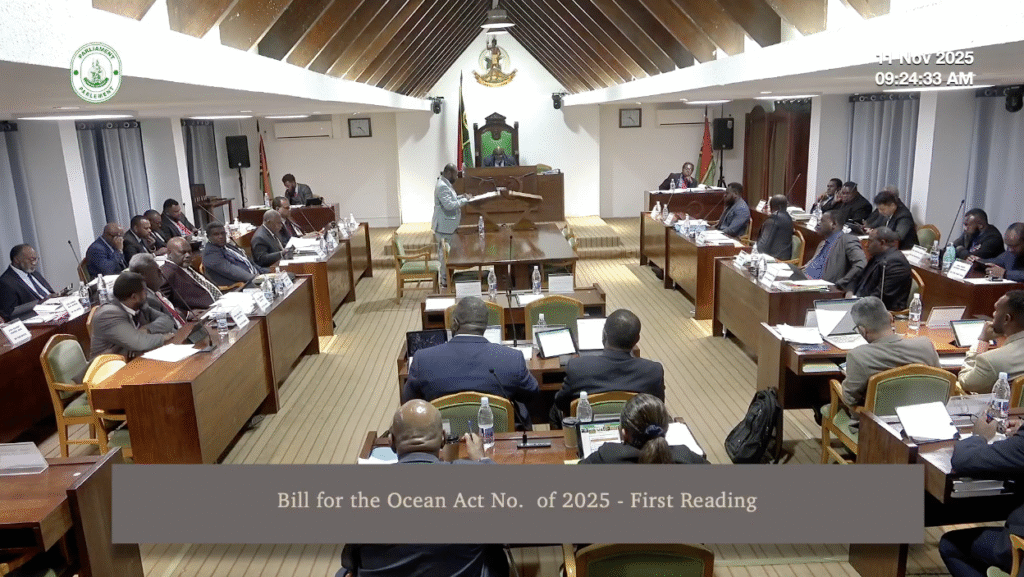
The Parliament of the Republic of Vanuatu yesterday introduced the Bill for the Oceans Act No. of 2025, marking a historic step toward sustainable management and protection of the nation’s vast ocean resources. The Bill was tabled by the Minister of Fisheries, Oceans and Maritime Affairs, Jack Norris Kalmet.
In his address to Parliament, Minister Kalmet said the proposed legislation represents a major step in Vanuatu’s efforts to safeguard its maritime rights and tackle the growing threats of climate change, marine pollution, and unsustainable exploitation of ocean resources. He noted that the Bill reflects the government’s long-term vision for ocean stewardship and national resilience.
The Bill provides a legal framework for the establishment and implementation of a Marine Spatial Plan, designed to oversee the management of Vanuatu’s entire ocean space, from the mean high-water mark to 200 nautical miles. The Plan aims to coordinate all ocean-related activities among government agencies, provincial authorities, and traditional leaders to ensure marine resources are managed for the benefit of current and future generations.
The Bill builds on the National Ocean Governance Framework approved by the Council of Ministers in 2012. This framework laid the foundation for Vanuatu’s comprehensive approach to ocean management and led to the creation of key institutions such as the National Committee on Maritime Boundary Delimitation, the Maritime and Ocean Affairs Division, and the National Ocean Policy—making Vanuatu the first Pacific nation to develop such a policy.
Under the proposed legislation, a Vanuatu National Ocean Council will be established to oversee the development and implementation of the Marine Spatial Plan. The Council will include senior government officials, such as the Directors of Fisheries, Environment, Tourism, Climate Change, and other relevant departments, along with the Chief Executive Officer of the Malvatumauri Council of Chiefs. This structure ensures that both government and traditional governance systems are represented in ocean management decisions.
The Marine Spatial Plan will classify Vanuatu’s ocean space into zones based on ecological and cultural significance. These include General Use Zones for sustainable activities, Sustainable Use Zones restricting large-scale commercial operations, No-Take Zones providing full ecosystem protection, and Tabu Zones governed by traditional prohibitions.
During the parliamentary debate, Members of Parliament voiced strong support for the Bill, noting that Vanuatu’s ocean resources have great potential to boost the national economy. They said the country’s marine wealth must be properly managed to ensure sustainable growth.
Prime Minister (PM) Jotham Napat said that with the Ministry of Oceans established and the Bill now before Parliament, the sector would deliver tangible economic benefits. He added that income from mackerel exports is projected to contribute around one billion vatu to the national budget, as confirmed by the Minister of Finance. The PM noted the timing of the Bill is important, coming just before Vanuatu’s delegation travels to France for the second round of talks regarding the islands of Matthew and Hunter.
Minister of Trade Samson Samsen also commended the initiative, noting that Vanuatu possesses valuable oceanographic data collected by a research program. He added that a recent expedition by the National Geographic team discovered new marine specimens in Vanuatu’s waters, reinforcing the importance of enacting the Bill at this time.
Minister Kalmet said the Bill aligns with Vanuatu’s national development priorities and international commitments, including its leadership role in the Commonwealth Clean Ocean Alliance, which the country co-chairs with the United Kingdom. He said the legislation demonstrates Vanuatu’s dedication to preserving marine biodiversity while ensuring the ocean continues to support the livelihoods and cultural heritage of its people.
The Bill also outlines penalties for violations, including fines of up to VT100 million for serious offences. It provides for the appointment of authorised officers to enforce the Act and introduces penalty notices to simplify enforcement procedures.
Following debate, a motion for the first reading of the Bill for the Oceans Act No. of 2025 was passed with 42 votes in favour. The Bill has been referred to the Parliamentary Standing Committee on Economic and Infrastructure Affairs for detailed scrutiny and public consultation. Once approved, the Act will come into effect upon publication in the Gazette.
Minister Kalmet reaffirmed the government’s commitment to ensuring that Vanuatu’s ocean space is managed sustainably, saying, “The ocean is not only our greatest resource but also our greatest responsibility.”