

Pacific Resilience Facility advances regional climate financing
September 15, 2026 11:01 pm | Posted in Business News | Share now TwitterFacebook
By Ezra Toara in Tonga.
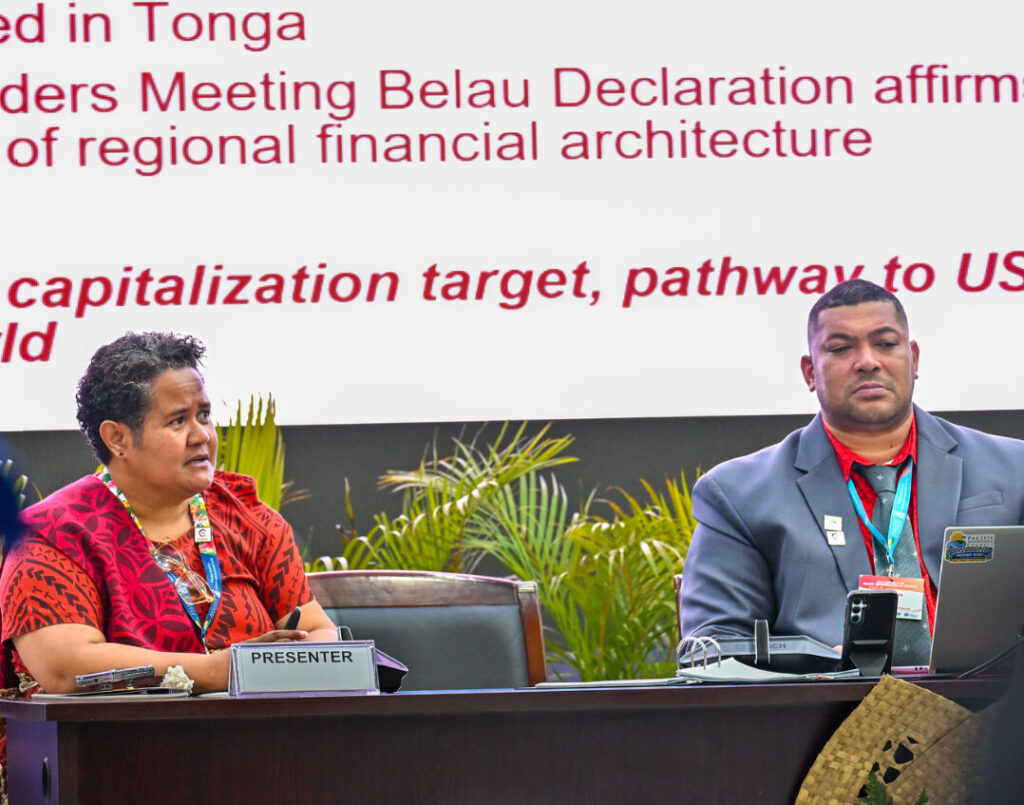
Pacific Resilience Facility (PRF) General Manager Finau Soqo has highlighted the progress made towards establishing the regional financing facility, describing it as a vision that has taken more than a decade to become a reality.
Soqo said this is really a vision that was conceived about 10 years ago to make climate financing more accessible to communities, and it is great to see that the PRF is now a reality.
She said the PRF has been established as a Pacific regional climate and disaster resilience financing facility and is collectively owned by Pacific governments.
The facility is intended to strengthen access to financing for communities affected by climate change and disasters, while also supporting resilience across the region.
Soqo said the PRF had evolved significantly since the original concept was developed, particularly following the COVID-19 pandemic.
She said the pandemic provided an opportunity for Pacific finance ministers to rethink and reframe the PRF, resulting in changes to its mandate and financing structure.
One of the changes was the creation of a separate disaster self-financing facility, as well as an expansion of the PRF’s mandate beyond adaptation and disaster preparedness and response.
The expanded mandate also recognises loss and damage, as well as the non-infrastructure needs of communities, including capacity building.
Soqo said the initial capitalisation target had been close to US$1.5 billion, but this was revised to US$500 million because of the funding environment following COVID-19.
She said the PRF’s business model is based on a grant investment model, where funds are invested to generate returns that can then be used to sustainably support the facility’s operations and provide financing to communities.
“The core of the PRF is, of course, our communities, to make climate financing accessible to the very last mile. This is our mission,” she said.
Soqo said not every community required large amounts of funding, with some projects potentially needing only US$10,000, while others could require US$150,000 or US$500,000.
She said the objective was to ensure that all members could access allocations from the PRF according to their community resilience needs.
However, she noted that demand for small-scale interventions was already significant.
One of the key principles of the PRF is to provide financing without creating additional debt burdens for Pacific communities.
Soqo said the facility would provide small grants while also developing its role as an international financial institution capable of undertaking financing arrangements unique to its regional mandate.
She said the PRF had already begun community impact demonstration grants as part of its development pathway.
The facility has two main grant pillars: disaster resilience programmes and community resilience grants.
Soqo said the first three years of the PRF would serve as a pilot period, with the facility preparing for longer-term reporting and operational cycles.
Under the grant system, members would receive allocations based on national priorities, while another financing stream would focus specifically on disaster preparedness, resilience and response.
She said funding for grants would begin before the investment component of the facility becomes operational.
Three pilot grant packages are being developed, including community impact demonstration funding and funding designed to support disaster preparedness and response.
Soqo said the PRF also plans to test the rapid release of funding following a disaster event so that communities can receive support for immediate resilience activities.
An annual funding cycle is also being developed, with applications opening during the first quarter, evaluation and awards taking place in the second quarter, implementation in the third quarter and reporting in the fourth quarter.
She said the aim was to make the small-grant funding predictable for Pacific members.
Governance and capitalisation
Soqo said the PRF’s governance policies and financial governance policies had been endorsed in principle.
A board has also been appointed and is undergoing the necessary vetting processes, while work is continuing on the investment arrangements for the facility.
She said the PRF had secured total capital pledges of about US$176 million and received additional funding support of around US$20 million.
The facility is targeting full collection of its pledged capital by the end of next year.
Soqo said the PRF was continuing its regional and international engagement to secure further support for its capitalisation efforts.
She stressed that the Pacific remained the focus of the capitalisation drive.
“If we invest US$500 million at five per cent conservatively, that is only US$25 million a year,” she said, explaining the importance of building the facility’s capital base.
She said the PRF needed to grow its capital so that investment returns could generate sustainable funding for its operations and community programmes.
Collaboration with weather and climate services
Soqo also highlighted opportunities for collaboration between the PRF and regional weather and climate services.
She described the relationship as a natural area of cooperation, particularly because the PRF’s role as a fund manager involves investing funds and generating income to support its operations.
She said collaboration could include supporting weather and climate services and helping manage investments to generate sustainable returns.
On the community side, Soqo said there was significant potential to work with remote communities that are located close to weather and climate monitoring instruments.
“This is a huge area of potential collaboration,” she said. She said communities could be supported to maintain weather instruments, build capacity and help ensure that valuable climate and weather data continued to be collected and used to improve services.
Soqo called for continued support from Pacific members and regional agencies as the PRF moves towards full establishment and operationalisation.
She also sought recognition of the PRF’s mandate as the region’s first Pacific-owned regional climate and disaster resilience financing facility and its role as an international financial institution.
She said the PRF would continue working with regional agencies and partners to explore investment arrangements that could support sustainable operations and strengthen climate and weather-related programmes.
“We are very happy to come back to the Secretariat to report on the progress of operationalising this facility,” Soqo said.