

Vanuatu opens organic export corridor to Australia
December 2, 2025 10:05 pm | Posted in Business News | Share now TwitterFacebook
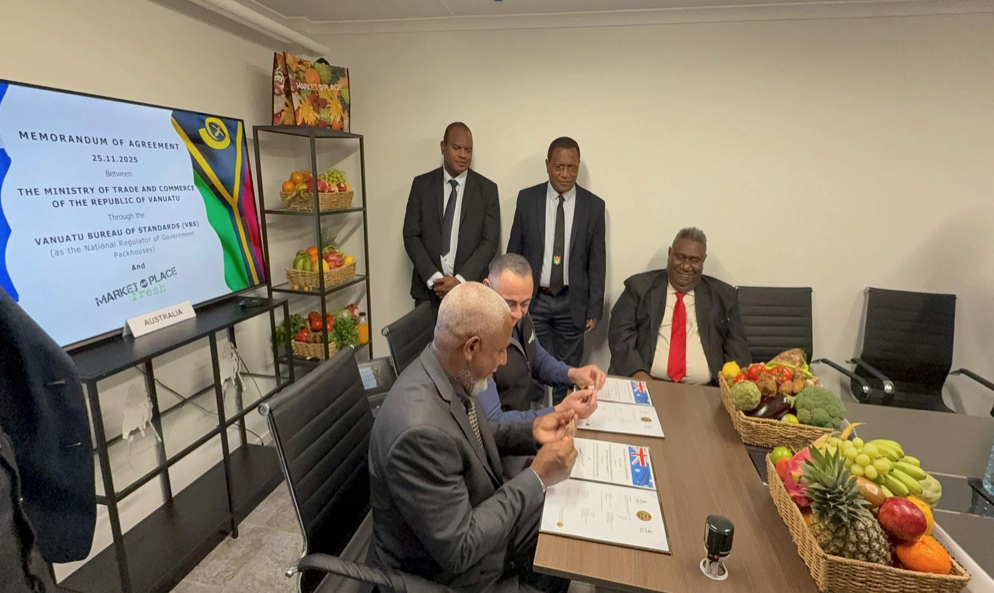
Vanuatu has opened a major new chapter in its trade and export development with the signing of a landmark Memorandum of Agreement (MOA) between the Ministry of Trade and Commerce (MOTC), through the Vanuatu Bureau of Standards (VBS), and MarketPlace Fresh, one of Australia’s largest distributors of premium produce.
The agreement establishes the first structured, standards-driven pathway for Vanuatu to supply the Australian market with premium organic fresh produce as well as Vanuatu-Made value-added products. The MOTC said this positions Vanuatu as a regional leader in natural, high-quality island goods and marks a major advancement in the country’s organic and value-added export strategy.
Minister of Trade Samson Samsen described the agreement as a breakthrough that elevates Vanuatu’s clean, organic agricultural identity and strengthens its emergence as a supplier of high-quality Vanuatu-Made products to the region.
Australia remains Vanuatu’s largest trade partner, accounting for nearly 30% of Vanuatu’s imports, with two-way trade reaching USD 543.1 million (around VT66.8 billion) in 2024. Increasing Vanuatu’s export presence in Australia is now a key component of the Government’s strategy to rebalance this long-standing trade dynamic.
The MOA creates a structured supply chain for organic fresh produce including volcanic-soil taro, premium root crops, seasonal fruits, island vegetables, and naturally grown produce that meet strict Australian biosecurity and hygiene standards. It also establishes a dedicated commercial channel for certified Vanuatu-Made food products, processed goods, and other value-added items destined for premium retail and wholesale markets in Australia.
Key provisions include the appointment of MarketPlace Fresh as exclusive importer and distributor, integration with Vanuatu’s national packhouse certification system, technical support for grading, packaging, quality control, and traceability, a Joint Steering Committee responsible for oversight and quarterly evaluations, and a renewable three-year operational framework to grow volumes progressively.
The Agreement was signed on behalf of Vanuatu by Joe Ligo, Director General (DG) of MOTC, and Atanas Pipite, Chief Executive Officer (CEO) of VBS. For MarketPlace Fresh, Stephen Fanous, Group Managing Director, and Silas Ling, CEO of World Best Trading (WBT), signed the agreement. Minister Samsen officially witnessed the signing.
The signing was also witnessed by members of the Vanuatu delegation, including Marcellino Pipite (First PA), Noel Kalo (Director of Industry), Albert William (Private Sector Representative), Gaspard Palaud (Chairman, VBS), Ernest Sumptoh, Acting High Commissioner of Vanuatu in Canberra, and Donald Pelam, Vanuatu Consul General in Sydney. Their diplomatic coordination helped ensure smooth facilitation of this historic engagement.
Member of Parliament (MP) Jones Malnimbwen, Chairman of the Parliamentary Committee on Foreign and Economic Policy, attended to scrutinise major government projects, assess policy implications, and ensure alignment with national objectives. MP Fred Samuel participated as the national political champion of the taskforce responsible for market development, inter-agency coordination, and project execution at the highest strategic and political levels.
The MOTC emphasised that the agreement is part of a broader export transformation strategy to brand Vanuatu as a reliable supplier of fresh, organic produce and high-quality Vanuatu-Made goods. Earlier this year, Vanuatu successfully entered the New Zealand commercial market with its first regulated export consignments, meeting strict international standards for packaging, cold-chain management, organic integrity, and product traceability. These shipments proved Vanuatu’s capacity to operate at global levels.
Building on that momentum, the Government strengthened packhouse operations, national logistics, certification systems, and farmer coordination. These advances now enable Vanuatu to scale confidently into larger markets, beginning with Australia.
The first export consignments under this agreement are expected as early as February 2026, following the commissioning of the Santo Packhouse, which has been upgraded to international processing and safety standards. The facility was constructed using Dincel’s internationally certified structural systems, ensuring global compliance with food-handling, hygiene, and biosecurity requirements.
This development aligns with the Government’s national policy to centralise standards as the key driver of export growth, supporting Vanuatu’s efforts to reduce Technical Barriers to Trade (TBT) and strengthen its position in premium international markets. Export volumes will expand through a certified supply chain, while organic and Vanuatu-Made value-added products will diversify national income streams. Hotels, resorts, supermarkets, and tourism operators within Vanuatu will also receive export-grade products, improving domestic food quality and reliability.
Given Australia’s dominant share of Vanuatu’s imports—including fuel, machinery, building materials, and consumer goods—the Government aims to rebalance the relationship by increasing exports of organic and Vanuatu-Made goods with higher market value. This agreement represents a step toward positioning Vanuatu as a competitive regional supplier of natural, sustainable, and value-added island products.
The MOTC acknowledges the Australian High Commission in Port Vila, the Vanuatu High Commission in Canberra led by Ernest Sumptoh, the Vanuatu Consulate General in Sydney led by Donald Pelam, past government officials and technical teams, Mr. Jason Thomas for establishing early linkages with MarketPlace Fresh, all Vanuatu farmers, producer groups, private-sector partners, VBS officers, and national stakeholders. Their combined efforts made this historic achievement possible.
This agreement positions Vanuatu as a regional leader in premium organic produce and Vanuatu-Made goods, bringing the purity of the islands to Australian consumers.