More seats to the islands: New Twin Otter joins a growing network
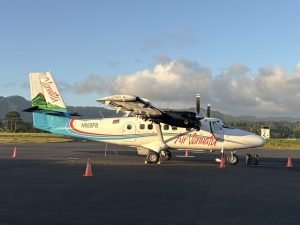
There are about to be more seats to the islands with the arrival of Air Vanuatu’s newest aircraft, a de Havilland Canada DHC-6 Twin Otter named Matagi Endeavour.
Built for short airstrips and island conditions and seating up to 19 passengers, it is the kind of aircraft Vanuatu’s domestic network is made for, and the Department of Tourism (DOT) joins the country in welcoming it home.
For the islands, those seats mean far more than tourism. They mean students and patients travelling when they need to, families reunited for ceremonies and holidays, kava and produce reaching market, and essential freight moving on schedule. And they mean visitors, the guests who fill bungalows, book tours and buy from the mamas at the markets, reaching the operators and communities who are ready to host them beyond Port Vila.
The aircraft arrives at an encouraging moment, coming after the most difficult period in the national carrier’s history, according to the DOT.
“Figures from Airports Vanuatu Limited (AVL) show passenger traffic through the 3 gateway airports, Bauerfield in Port Vila, Pekoa in Luganville and Whitegrass on Tanna, rose 31% in the 12 months to June 2026, to 543,972 passengers,” said the department.
“Whitegrass is the fastestgrowing airport in the network, up 59%, and Bauerfield has now passed the levels it recorded before the disruptions of 2024. International visitor arrivals data published by the Vanuatu Bureau of Statistics tells the same story throughout 2026.
“Because every international visitor bound for Santo or Tanna first clears Bauerfield before connecting onward, growth at the international gateway flows directly into the provinces, and the Pekoa and Whitegrass figures show that it is doing exactly that. The task now is to keep that growth moving beyond the gateways to the rest of the country.
“That is the job of the Twin Otter. It will strengthen Air Vanuatu’s domestic schedule between Port Vila, Luganville and Tanna and onward to the outer islands, adding the seats, frequency and reliability needed to carry people and opportunity beyond the main gateways, in line with the Government’s objective of dispersing visitor growth to the outer islands.”
For the DOT, this is ultimately about destination development.
“Every additional visitor moving through the gateways means more guests for accommodation, tour and transport operators across the islands, more income staying in local communities, and more confidence for operators to invest in their businesses, lift their standards and grow the base of tourism products that Vanuatu offers. That is the growth the Department wants to see, and the new aircraft will help carry it further,” said the department.
DOT is also very positive about the announcement made during the arrival ceremony by the Deputy Prime Minister (DPM) and Minister of Finance, Johnny Koanapo, that the Government has secured additional funding not simply to rehabilitate but to restructure the Bauerfield terminal, improving the first impression Vanuatu makes on arriving visitors and expanding the terminal for a better visitor experience.
The additional allocation for Bauerfield is a clear demonstration of the commitment the Government is putting behind the country’s main gateway, said the DOT.
As the DPM noted, the Government’s agenda in the period ahead is about strengthening the tourism sector, including the further expansion of Air Vanuatu’s domestic fleet through the acquisition of an additional ATR 72, and a programme to ensure that airports across the country are properly reviewed and upgraded.
He mentioned Norsup Airport on Malekula, and of the work being explored for Motalava to accommodate ATR 72 aircraft in the future, investments that will extend reliable air access deeper into the provinces, exactly where the growth now coming through the gateways needs to go.