DARD Director wants farmers to become millionaires on their own land
By Nicholas Mwai.
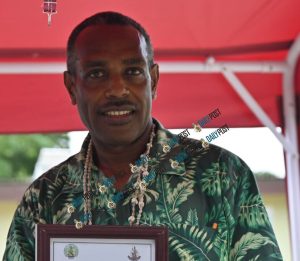
Department of Agriculture and Rural Development (DARD) Director Antoine Ravo wants to see farmers in Vanuatu become millionaires from their own land, challenging 70 graduates of a 45-day vegetable cultivation training course to turn their new skills into productive farms and successful businesses.
Speaking at the course’s closing ceremony, Mr. Ravo said the training would only be worthwhile if farmers applied what they had learned and increased production.
“I want to see farmers become millionaires on their own land,” he said.
He said farmers should not depend entirely on the DARD to solve their problems, but take responsibility for developing their farms with the knowledge and support provided through training.
“After this training, we need to see action. We want people to work. A lot of people see the Department of Agriculture as the answer to all their problems. Yes, we can help, but it is up to the farmers to work. We can provide training, but the work is up to the farmers,” he said.
The 70 graduates completed a programme combining classroom lessons and practical fieldwork to improve vegetable cultivation and strengthen local agricultural production.
Of the graduates, 50 were involved in the Agriculture Business Permit process, including those whose applications were still being processed, while the other 20 were interested participants.
The training covered seed selection, sowing, seedling production, field management, pest and disease control, improved vegetable varieties and modern farming methods.
Participants also gained practical experience in developing vegetable gardens and constructing greenhouses.
DARD said the programme formed part of ongoing efforts to move farmers from subsistence farming towards semi-commercial and commercial production, helping them earn income from their land while supplying local markets.
The department is also exploring ways to provide further assistance through seedlings, demonstration plots, machinery and farming equipment to help graduates continue production after the course.
Chen Xiaoliang, Technical Director and Manager of the Longping High-Tech International Training Academy, said the programme had helped participants understand vegetable cultivation technology and the potential to expand production in Vanuatu.
“Through classroom lectures, everyone has gained a thorough understanding of vegetable cultivation and planting technology and the current state of the vegetable industry,” he said.
He said practical activities gave participants a clearer understanding of how improved farming techniques could be applied in local conditions.
“More importantly, the students have gained a more direct understanding of large-scale and standardised vegetable production and have strengthened their confidence in developing the local vegetable industry in Vanuatu,” Mr. Chen said.
He thanked the Ministry of Commerce of China, the Chinese Embassy in Vanuatu, DARD and other partners for supporting the training.
Mr. Chen said Longping High-Tech had organised overseas training courses in Vanuatu in 2017, 2018, 2019 and 2023, adding that the 2026 programme would provide a foundation for further cooperation.
“Although this training has come to an end, I believe it marks the beginning of new cooperation,” he said.
He encouraged graduates to use their new skills on their farms and share their knowledge with others to support food security in Vanuatu.
Chinese Embassy Counsellor Chen Zongwei said the programme attracted strong interest from local people, with attendance reaching 117 at its peak.
He said the course combined classroom lessons with fieldwork covering seed selection, sowing, seedling raising, field management, pest and disease control, improved vegetable varieties and better farming methods.
“The experts did not only teach in the classroom, but also went into the fields and worked side by side with the participants, helping them understand how to apply these techniques in real farming conditions,” Mr. Chen said.
He said the knowledge gained could help farmers diversify their crops, expand cultivation areas, increase agricultural supply and improve their incomes.
“Agriculture is one of the key industries which plays a significant role in social and economic development. Agriculture is an important part of people’s daily lives. It provides food for our families, creates jobs and supports the development of local communities,” he said.
Mr. Chen said agricultural cooperation was an important part of the relationship between China and Vanuatu, with China supporting agricultural development through technical assistance projects and training programmes.
He encouraged graduates to share their skills with their families, friends and other farmers, saying they could become local leaders in vegetable production and help others benefit from improved agricultural technology.
Acting Deputy Secretary of the Public Service Commission (PSC), Ini Tristan Tabiaga, told graduates that the real value of the training would be measured by their achievements after returning home.
“The real achievement is what happens after today. The real question is not what you learn, but what you will start doing in the next 12 months, in 24 months and in five years,” he said.
Mr. Tabiaga said the programme represented an investment of time, resources, training and equipment, and its benefits needed to be demonstrated through improved production and stronger farming businesses.
“The benefit does not arrive on graduation day. The certificate is not the return. The return is measured in what happens afterwards,” he said.
He said successful outcomes should include higher yields, better-quality vegetables reaching markets, fewer food imports, increased local production, lower production costs and higher incomes for farming families.
Mr. Tabiaga challenged graduates to apply at least one technique from the course on their farms within 30 days of returning to their communities.
Within 90 days, he encouraged them to organise practical demonstrations and share their skills with other farmers, colleagues or young people.
“Evidence is your best argument. When you can show a better harvest, people will believe you far faster than if you only tell them,” he said.
He added that graduates should report their progress to DARD or the PSC so the programme’s results could be assessed and improvements identified.
Mr. Tabiaga said agriculture remained central to Vanuatu’s development goals because many people depended on the land for their livelihoods.
“Healthy local vegetable production means better nutrition, a stronger rural economy and less dependence on imports,” he said.
He congratulated the graduates but reminded them that completing the course was only the beginning of their responsibility.
“Go home, plant, teach, measure and report. Show us, and show Vanuatu, that this investment was worth every vatu and every hour you spent,” he said.
The challenge now is for graduates to apply their training, increase production and build viable businesses that improve their livelihoods while strengthening Vanuatu’s local food supply.