Chinese experts train farmers in vegetable production
By Nicholas Mwai.
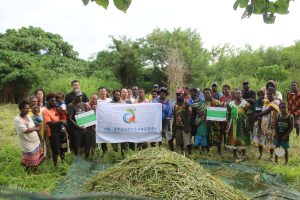
More than 60 farmers have received practical training in vegetable production at Vanuatu Efate International School.
A team of three Chinese agricultural experts helped local farmers improve their farming skills, increase yields and strengthen food production in Vanuatu.
The seven-day training combined classroom sessions with field demonstrations, allowing farmers and students to learn improved cultivation techniques and apply their knowledge directly on the farm.
The program was delivered by experts from the Jiangsu Academy of Agricultural Sciences (JAAS), working with the Vanuatu Agricultural Research and Technical Centre (VARTC) under Phase II of the Global South-South Development Centre (GSSDC) project.
A Researcher at the Jiangsu Academy of Agricultural Sciences, said the training was designed to help farmers improve vegetable production through practical, affordable and labour-saving techniques suited to local conditions.
“Vegetable production is a basic livelihood industry in Vanuatu, but it faces the challenge of insufficient production capacity,” said Pan Baogui.
Baogui explained that the program aimed to help farmers master techniques that could improve the quality and quantity of vegetables they produce.
The training covered a range of methods, including seedling production using plug trays, converting agricultural waste into fertiliser, fertigation, integrated pest and disease management, vertical trellising for cucumbers and single-stem pruning for tomatoes.
Participants also learned about improved vegetable varieties, with the program covering approximately 20 crops, including tomatoes, peppers, eggplants, cucumbers, pumpkins, bitter gourds, zucchini, watermelons, melons, beans, cabbages, carrots and leafy vegetables.
The practical sessions allowed farmers to see how the techniques could be applied in the field, while providing opportunities to ask the experts questions about vegetable cultivation.
Baogui said the three experts brought different areas of agricultural expertise to the program.
They were Wang Xuanqing, Assistant Researcher at the Jiangsu Academy of Agricultural Sciences; Dai Xibin, Associate Researcher at the National Sweet Potato Research Centre, Xuzhou Institute of Agricultural Sciences; and Pan Baogui, Researcher at the Jiangsu Academy of Agricultural Sciences.
Their specialisations included chilli pepper breeding and cultivation, sweet potato breeding and cultivation, and soil improvement and functional fertiliser development.
During the training, Dai delivered a lecture titled ‘Magic Sweet Potato: Not Just a Food’, while Wang presented on simple composting and low-cost soil fertility improvement using agroforestry residues.
Pan said the training was the second session conducted under the project in Vanuatu, following the first session in April 2026, which focused on improved vegetable varieties and efficient production techniques.
He said the latest session built on that earlier training by giving participants further opportunities to understand and practise techniques relevant to local vegetable production.
The program also included local students, giving them an opportunity to learn about modern farming methods and gain practical agricultural experience.
Lucas Wang, principal of Vanuatu Efate International School, said exposing students to agriculture was important because not all of them would eventually work in offices.
“Students are taking this training is important because they will all not end up in the offices.
They will grow up to become parents, and basic ideas or knowledge on agriculture will help them a lot,” he said.
He said agricultural knowledge could benefit students and their families in the future, particularly in a country where many people depend on farming for their livelihoods.
Wang explained that students could use what they learned to grow their own food or share the knowledge with their parents, helping families improve food production and potentially earn income by selling vegetables at local markets.
He said the income generated from farming could help families meet household expenses, including school fees.
The inclusion of students also provides an opportunity to develop agricultural knowledge among younger generations, while farmers can apply the techniques to their existing production activities.
The project has established a vegetable production demonstration base in Port Vila, equivalent to approximately 3.3 hectares, to promote improved vegetable varieties and efficient cultivation technologies.
Through the partnership between JAAS and VARTC, the project aimed to demonstrate farming methods that can help local producers improve productivity and make more effective use of available agricultural resources.