
New law to establish information and communications regulator
October 20, 2026 10:43 pm | Posted in Business News | Share now TwitterFacebook
By Ezra Toara.
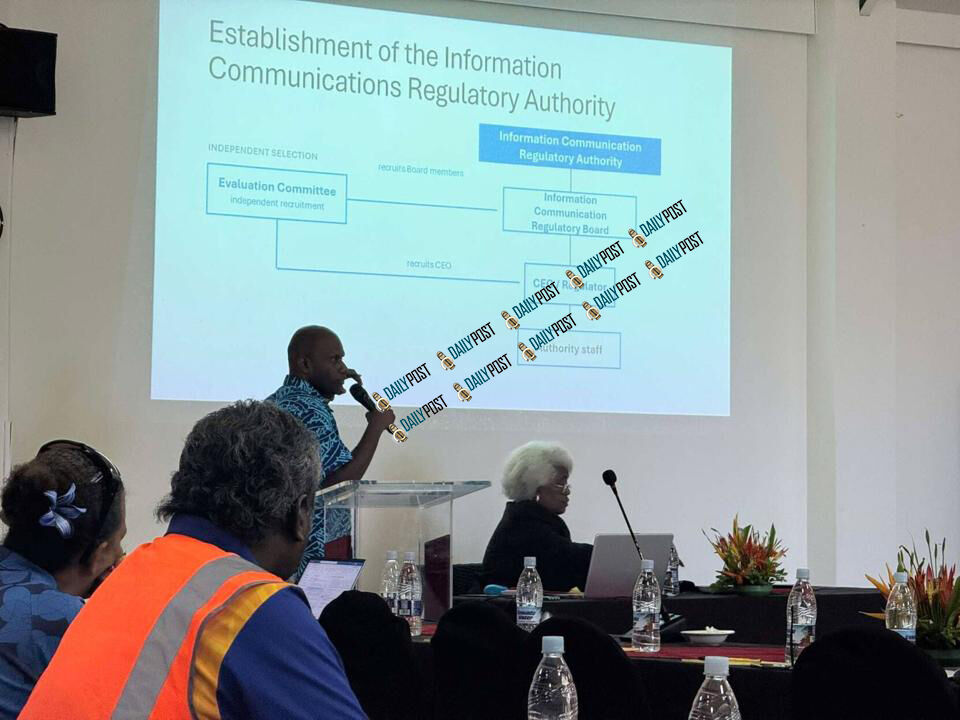
The existing Telecommunications and Radiocommunications Regulator (TRBR) and Telecommunications Acts are scheduled for repeal during the upcoming Parliamentary Session and will be replaced by a new legislative framework establishing the Information and Communications Regulatory Authority of Vanuatu (ICRAV).
The proposed changes were outlined during a stakeholder consultation at The Melanesian Hotel yesterday, where Regulator Jesse Benjamin and his team presented details of the new legislative framework.
The consultation provided stakeholders with updates on the proposed reforms, outlined changes to the regulatory structure and allowed participants to raise questions about the transition to the new authority.
The proposed framework aims to establish a regulatory system aligned with Vanuatu’s national development goals.
Functions of the authority
Mr. Benjamin explained that ICRAV would be established as a body corporate with perpetual succession and a common seal, giving it the legal capacity to sue and be sued.
The authority would develop policies and standards for broadcasting, radiocommunications and telecommunications. It would also conduct research and regulatory sandbox activities to improve affordability, access and competition across the information and communications sector.
Its responsibilities would include representing consumers and service providers in matters involving overcharging and undercharging, mediating disputes between consumers and providers, seeking compensation for consumers where appropriate, arbitrating disputes between providers and undertaking cost modelling.
The authority would also have operational powers to hold property, enter into agreements, require consultation with service providers and charge fees.
Regulatory board and governance
The proposed authority would be overseen by a three-member Regulatory Board comprising a chairperson and two other members appointed by the Minister on the recommendation of an Evaluation Committee.
Board members would need relevant tertiary qualifications and at least five years of experience in the sector. Appointments would be based on merit and conducted through fair and transparent processes.
The Board would oversee sector policies and standards, capital allocations, annual budgets, major expenditure, acquisitions, dividends and investments.
Members would serve five-year terms, with the option of one reappointment. The Minister would appoint the chairperson from among the Board members.
The Board would meet at least quarterly, with two members required for a quorum. The presiding officer would have a casting vote in the event of a tie.
Mr. Benjamin said the Regulator would serve as the Board’s secretariat.
Independence and integrity safeguards
The proposed legislation would include safeguards to protect the authority’s independence and integrity.
Restrictions would prevent political office holders, political-party executives, people with serious criminal convictions, and owners or shareholders of service providers from serving in roles where their interests could compromise the authority’s independence.
Conflict-of-interest rules would require members to declare any conflicts and prevent those affected from participating in related deliberations.
Benjamin said the objective was to establish an independent regulatory institution supported by Board oversight, a professionally qualified Regulator, impartial appointment processes and sufficient staff capacity to administer the Act.